
Lowndes Projected and Actual Release
A projected date is an estimate or calculated sentence point. An actual release date records when custody under a specific agency ended. Those are not interchangeable. The Georgia Department of Corrections uses maximum-term concepts for state offenders. The Parole Board uses Tentative Parole Month, or TPM, for a possible parole review point. Lowndes County Jail records, bond records, and court orders control the county track.
A pretrial detainee has not yet received a final jail sentence. There may be no sentence end date to calculate. Release could occur after bond is met, a judge changes conditions, charges are dismissed, another authority takes custody, or the case reaches disposition. A sentenced person may have a term, but credits, mandatory-service rules, parole action, or holds can change the practical date.
- MRD
- Maximum Release Date, a GDC sentence-expiration concept that may reflect eligible credits.
- TPM
- Tentative Parole Month, when the Board expects final review. It is not a release grant.
- Detainer
- A request that another authority hold or receive the person.
- Discharge
- The official end of the sentence or agency supervision.
Lowndes Release Date by Custody
Lowndes County contains three facilities with different record owners. Lowndes County Jail is operated by the Sheriff's Office. Valdosta State Prison and Valdosta Transitional Center are GDC facilities. A date tied to one system does not establish release from another. The GDC search may list Lowndes County Jail as a most recent institution for some state records, but that does not turn the state search into the county jail roster.
| Custody track | Best date source | What to verify |
|---|---|---|
| Lowndes County Jail, pretrial | Jail record, bond record, and court docket | Bond, order, dismissal, transfer, or hold resolution |
| Lowndes County Jail sentence | Sentencing order, jail record, and sheriff records office | Sentence credit, completion, or transfer as actually recorded |
| Valdosta State Prison | GDC offender record and Parole Board tools | MRD, sentence status, TPM, parole decision, or detainer |
| Valdosta Transitional Center | GDC, Parole Board, and DCS | Parole, sentence completion, transfer, or supervision plan |
| Federal or immigration custody | BOP or ICE locator and federal court record | Release from that authority, not merely from Lowndes custody |
The first task is therefore classification, not arithmetic. Once the custody owner is known, use its dates and terms. This prevents a county bond date, state MRD, and parole TPM from being blended into one false prediction.
Find Lowndes Projected Release Dates
The GDC offender search provides active, inactive, and combined scopes. It accepts a name, GDC ID, or case number. Filters include most recent institution, conviction county, primary offense, and sentence status. For a person expected to leave state custody soon, the form includes “Max Prison Term Ending Next 15 Days.” Its “Released In The Past 15 Days” option looks backward after a state release. Neither filter is a Lowndes County Jail feed.
- Identify the custody agency and compare full identifying details.
- For a state prisoner, search GDC active records by name, GDC ID, or case number.
- Review the individual state record for sentence and release context; do not infer a date from “most recent institution.”
- Open the Parole Board TPM tool if parole consideration applies, and treat the TPM as tentative.
- For the county jail, check the Odyssey jail and bond records plus the Lowndes court docket.
- Ask the sheriff records office or GDC Inmate Records and Information for written verification when exact proof is needed.
The Lowndes County released-inmate search provides the broader path for confirming what happened after someone leaves a roster. It is useful when the expected date has passed but no release reason is clear.
Lowndes GDC Release Search Fields
GDC's inactive scope means not currently incarcerated in GDC. That can support a past state-release check, but it does not identify every later custody or supervision event. The “Released In The Past 15 Days” filter is statewide. A Lowndes conviction or Lowndes-area institution can narrow results, yet the resulting record still belongs to the state system.
| Search field | How it helps |
|---|---|
| Active, inactive, or both | Separates current GDC incarceration from records not currently incarcerated. |
| GDC ID or case number | Reduces name-match errors and links the right state record. |
| Most recent institution | Can narrow to Valdosta State Prison, Valdosta TC, or listed Lowndes institutions. |
| Conviction county | Can narrow state records to a Lowndes County conviction. |
| Sentence status | Provides the next-15-day maximum-term and past-15-day state release filters. |
GDC warns that its public search may not be complete and directs written verification to Inmate Records and Information, PO Box 1529, Forsyth, GA 31029. That verification step is appropriate when a date must be documented rather than merely checked online.
Lowndes MRD Versus Parole TPM
MRD and TPM answer separate questions. MRD relates to the maximum sentence end after applicable state rules and credits. TPM is the month when the Parole Board plans final review and may set a parole release date. The Board states plainly that a TPM is not a final decision. It may depend on good conduct and completion of required programs.
The Board may accept or reject its guideline recommendation, deny parole, establish a TPM, postpone or cancel the TPM after misconduct, or withdraw a grant before its effective date. An acceptable residence plan is also required before parole release. Verification of that plan occurs as a tentative grant and TPM approach. Thus, even a current TPM should never be restated as a guaranteed release day.
The Board's TPM explanation is the official source for that distinction.
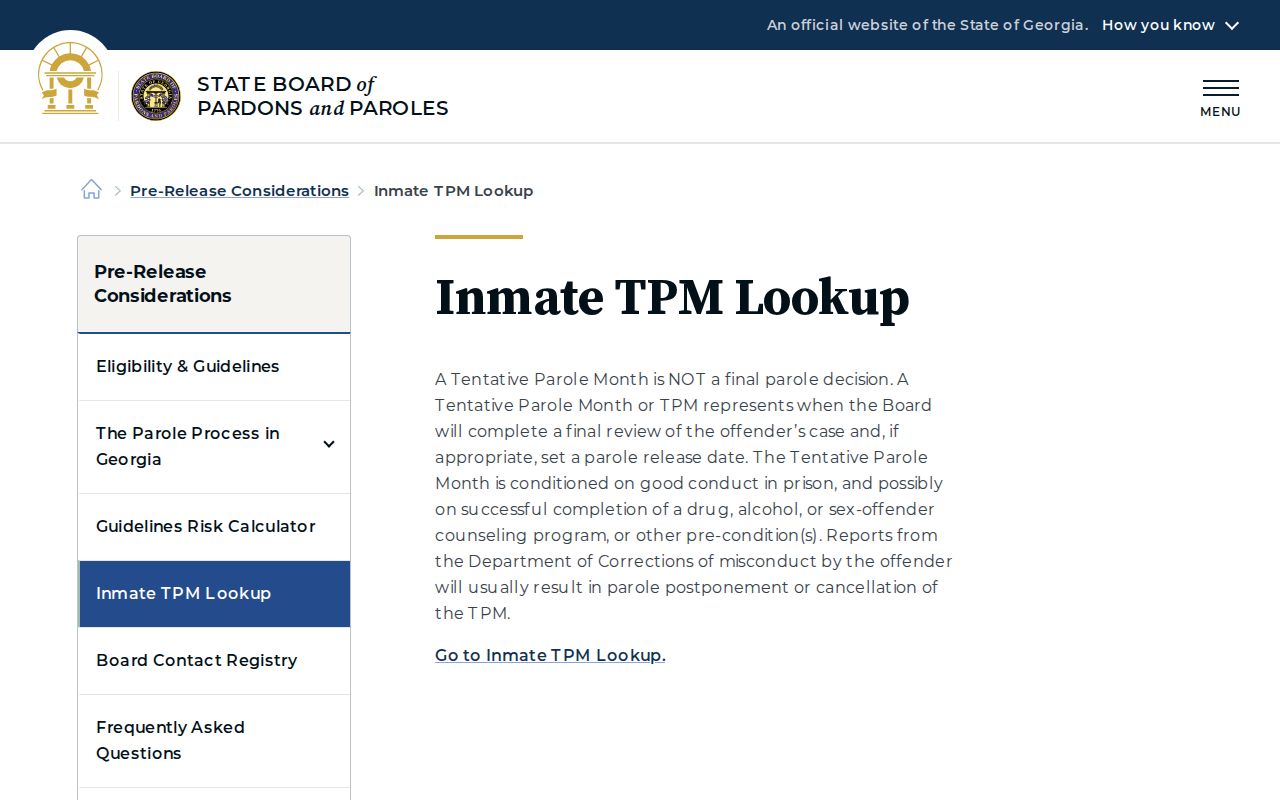
The captured page reinforces why a tentative review month must be checked again before anyone treats it as an actual Lowndes-area release.
Georgia Credits Affect Lowndes Release
GDC's Performance Incentive Credit program, or PIC, can affect eligible state offenders. GDC says participants may earn up to 12 points and potentially receive one to twelve months off the TPM or MRD. Points may come from case-plan work, educational or vocational gains, and work or detail assignments. PIC is a state correctional program. Research found no published Lowndes County Jail formula that would justify applying PIC or a similar estimate to a county sentence.
Some offenders are excluded from PIC. GDC lists death sentences, terms of two years or less, life sentences, non-parole-eligible cases, and minimum-mandatory offenses among the exclusions. Eligibility must be checked against the person's actual sentence. Credits can change a state date only within the rules that govern that sentence.
Note: No researched Lowndes jail source published a county good-time or weekend-release formula, so court and jail records must control.
Georgia Law Shapes Lowndes Dates
O.C.G.A. § 42-9-45 sets Georgia's general parole-eligibility framework. It generally permits felony parole consideration after nine months or one-third of the sentence, whichever is greater, unless another statute applies. Eligibility for consideration does not guarantee release. The Board retains the parole decision role.
O.C.G.A. § 17-10-6.1 covers listed serious violent felonies and imposes stricter service rules and limits. Recidivist and other minimum-mandatory provisions may also affect eligibility. Georgia should not be reduced to a universal “85 percent rule.” The Parole Board uses guidelines with sentence-percentage recommendations, and mandatory rules depend on the offense and sentence. The actual judgment and applicable statute are more reliable than a broad percentage estimate.
Why Lowndes Release Dates Change
A projected date can move because several legal and administrative events remain open. Some shorten the projected state term. Others delay departure or redirect the person to another authority. Each change should be confirmed through the agency that made it.
| Factor | Possible effect | Confirmation source |
|---|---|---|
| PIC eligibility and points | May reduce an eligible TPM or MRD within GDC rules. | GDC offender and program records |
| Misconduct | May postpone or cancel a TPM or affect credits. | GDC and Parole Board records |
| Parole decision | May deny, set, change, or withdraw a tentative release path. | Parole Board tools and records |
| Detainer or hold | May shift the person to another authority rather than home. | GDC, jail, court, and receiving authority |
| Court order | May alter bond, sentence, credit, or custody status. | Lowndes court docket and signed order |
| Residence plan | May affect whether a parole release can proceed. | Parole Board and DCS |
A parole to detainer is called a conditional transfer. The person has left GDC under the parole action but moves to the requesting authority. The label “released” must therefore be read with the destination field and not assumed to mean release into the community.
Lowndes Jail Date Confirmation
The Lowndes County Jail path is based on records, not a public formula. Search the Odyssey/PublicAccess jail and bond records. Then inspect the county court portal for the order or case event. A bond entry may show why a person could leave while charges remain pending. A sentencing entry can establish time served, probation, or a term. A transfer entry may explain why the person vanished from the current-inmate view without going home.
When the online record does not show the needed date, use the sheriff's records request or open-records form. Include the full name, date of birth if known, booking or approximate custody dates, case number, and the precise record requested. Ask for a release sheet, bond release entry, transfer record, or other named item. Avoid asking the office to calculate an unsupported projected date.
Confirm Lowndes Actual Release
Check the date again near the expected event. For state custody, review GDC and the Parole Board, then confirm with the agency if the person must be met or the date must be documented. For county custody, use the jail record and court order. Georgia VINELink can add a custody-change alert when the participating agency supplies the record.
A VINE alert is not the legal reason for release. It may report a custody change without specifying bond, time served, parole, discharge, or transfer. The Lowndes VINELink inmate search describes how to follow one person and register for notices. After an alert, confirm the cause and destination with the jail, court, GDC, or Parole Board record.