
Valdosta Prison Release Routes
Valdosta State Prison is operated by the Georgia Department of Corrections. It holds sentenced state offenders, so release authority and records remain with state systems. A person leaving the prison may be paroled to community supervision, discharged when the sentence ends, transferred to another GDC location, or moved to another authority under a detainer. A detainer is a request or hold from another agency. It can mean that departure from the prison is not a return home.
GDC offender data is the first release source. The Georgia State Board of Pardons and Paroles handles parole decisions and maintains tools for tentative parole status and released parolees. The Georgia Department of Community Supervision manages field supervision for parolees and felony probationers. Each agency answers a different question. GDC shows state custody and sentence information, the Board shows parole status, and DCS provides the post-release supervision layer.
The Lowndes County Jail current-inmate view does not confirm any Valdosta State Prison release. Physical location in Lowndes County does not change the prison's state status. Use the Lowndes County released inmates overview only to distinguish the three local custody tracks and then stay with the state path for this facility.
Search Valdosta Prison Releases
Open the GDC offender search and accept its disclaimer. Search by name, GDC ID, or case number. The name route supports more filters, including most recent institution, primary offense, conviction county, sentence status, and physical identifiers. Select Valdosta State Prison as the most recent institution when that filter fits. It narrows the results but does not prove that the person was released directly from that prison.
- Choose inactive records or both active and inactive records.
- Enter the full name, GDC ID, or case number.
- Compare birth, physical, offense, and institution details.
- Open the matching individual offender record.
- Read status, most recent institution, sentence, and release-related fields.
- Check parole tools when a parole release may apply.
- Request written GDC verification when exact proof is required.
Inactive means not currently incarcerated in GDC. It does not by itself identify discharge, parole, transfer, or later custody elsewhere. GDC also offers statewide sentence-status filters for Released In The Past 15 Days and Max Prison Term Ending Next 15 Days. Those filters are state windows, not Lowndes County recent-release lists.
Valdosta Release Record Fields
An individual state offender record can contain several clues, depending on record type and availability. Read them together and match the identifying data before relying on a release field. GDC warns that public information must be verified through written correspondence when completeness matters.
| Field | Release meaning |
|---|---|
| Active or inactive status | Whether GDC reports current incarceration. |
| Most recent institution | The latest GDC institution history shown, not a release date. |
| Maximum release context | Sentence-end information, distinct from parole review. |
| Offense and conviction county | Case context used to match the correct record. |
| GDC ID or case number | Identifiers for search and written verification. |
| Photograph | An offender image displayed automatically when available. |
A maximum release date, often called MRD, relates to the sentence end and applicable credits. A Tentative Parole Month, or TPM, is a future Board review stage. It is not a promised release date. A released state offender may still be under DCS supervision, so the custody record and supervision record should not be treated as interchangeable.
Valdosta Parole Release Checks
The Georgia State Board of Pardons and Paroles links two different public tools. The Inmate TPM Lookup applies before release and can show tentative parole status. The Parolee Database applies after parole and can confirm that the person is listed as a parolee. The Board defines a TPM as the month in which it expects to complete final review and, if appropriate, set a release date. Conduct, program completion, a detainer, or a later Board decision can change the outcome.
Georgia's general parole eligibility law, O.C.G.A. § 42-9-45, generally makes felony offenders eligible for consideration after nine months or one-third of the sentence, whichever is greater, unless another rule applies. Serious violent felony and minimum-mandatory rules can limit parole. Eligibility means consideration, not approval.
After parole takes effect, the parolee record and DCS field office become more useful than the pre-release TPM. DCS Valdosta serves Lowndes and nearby counties for state parole and felony probation supervision. It can clarify the local reporting context, but it does not replace the Board's decision record or GDC's custody history. A person can also complete a sentence without parole, in which case a parolee search may correctly return no match. Always choose the tool that fits the release type.
- Parole
- Conditional release from prison under state supervision before sentence authority fully ends.
- Discharge
- The end of state sentence or correctional authority.
- TPM
- A tentative parole-review month, not a final date.
- Detainer
- A hold or request from another authority that can affect destination.
Valdosta Prison Records Contact
GDC lists the facility address and phone for direct institution contact. Questions about an offender record should use GDC search and records channels. Its public search specifically directs formal verification to Inmate Records and Information rather than treating the screen as complete proof.
3259 Valtech Road
Valdosta, GA 31601
Phone: 229-333-7955
PO Box 1529
Forsyth, GA 31029
Include the full name, GDC ID if known, case number, and the exact status or release field that must be verified. General GDC correspondence uses official state records channels. Do not route this prison release request through the sheriff, since the county did not create the state offender discharge record.
A focused request should state whether the needed item is confirmation of inactive status, an actual release date, sentence discharge, institution history, or a transfer. These are not the same record question. Save the public result and note the date it was checked, since status can change. If the person is said to be on parole, compare the response with the Parolee Database. If another agency received the person, continue with that receiving authority rather than treating the GDC departure as final discharge.
Valdosta State Prison Profile
The official GDC facility profile identifies Valdosta State Prison as a close-security institution for adult male felons. GDC lists capacity at 1,312 and reports paired construction and opening dates of 1988/1956 and 1989/1959 for the complex and its components. The profile describes general population units, mental-health units, isolation, acute care, crisis stabilization, an annex, and a residential substance abuse center.
The official facility source is shown below.
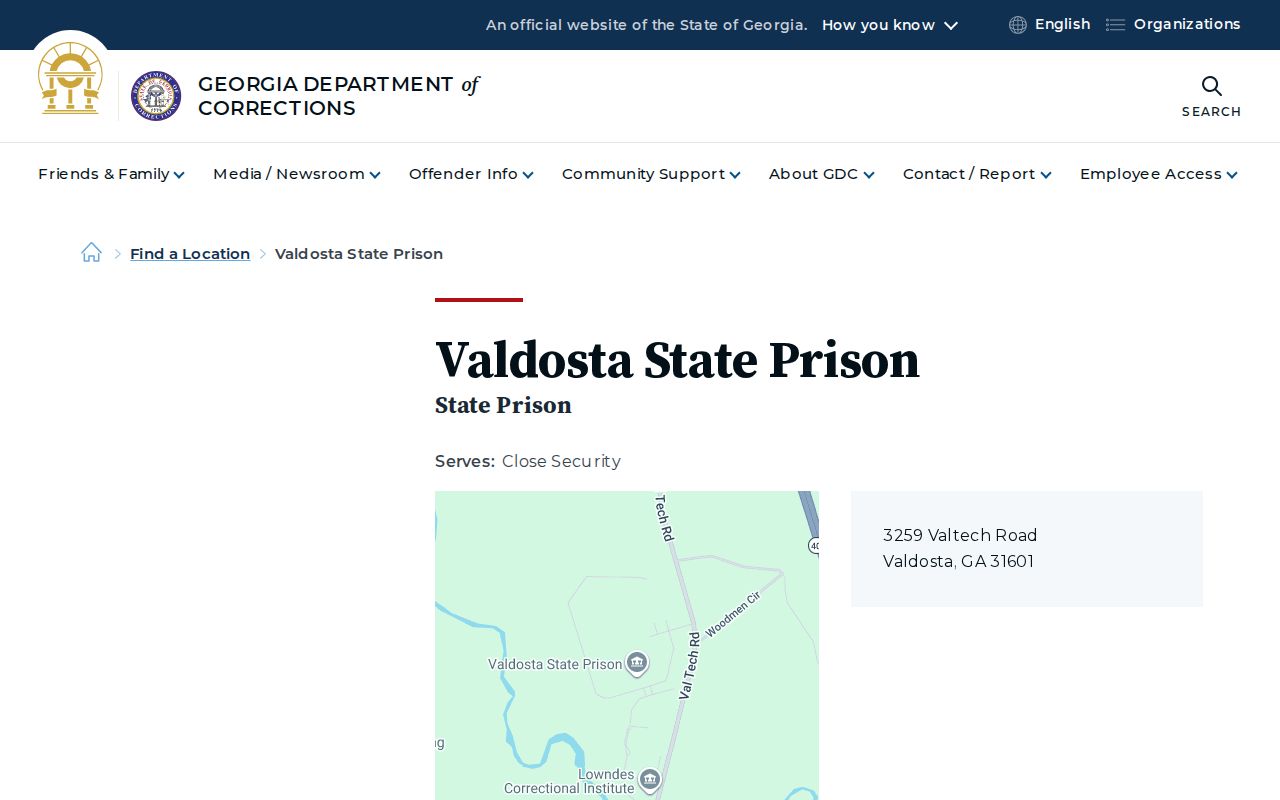
The profile confirms why all release research for this institution belongs in state correctional, parole, and supervision systems.
Valdosta Prison Reentry Programs
GDC says Valdosta State Prison provides academic, vocational, mental-health, and counseling programs. The annex includes medium- and minimum-security offenders and outside work details. Program participation is part of the institution's correctional setting, but it does not establish that a person has been released or provide a final parole date.
The GDC reentry and cognitive programming source provides the state context shown below.
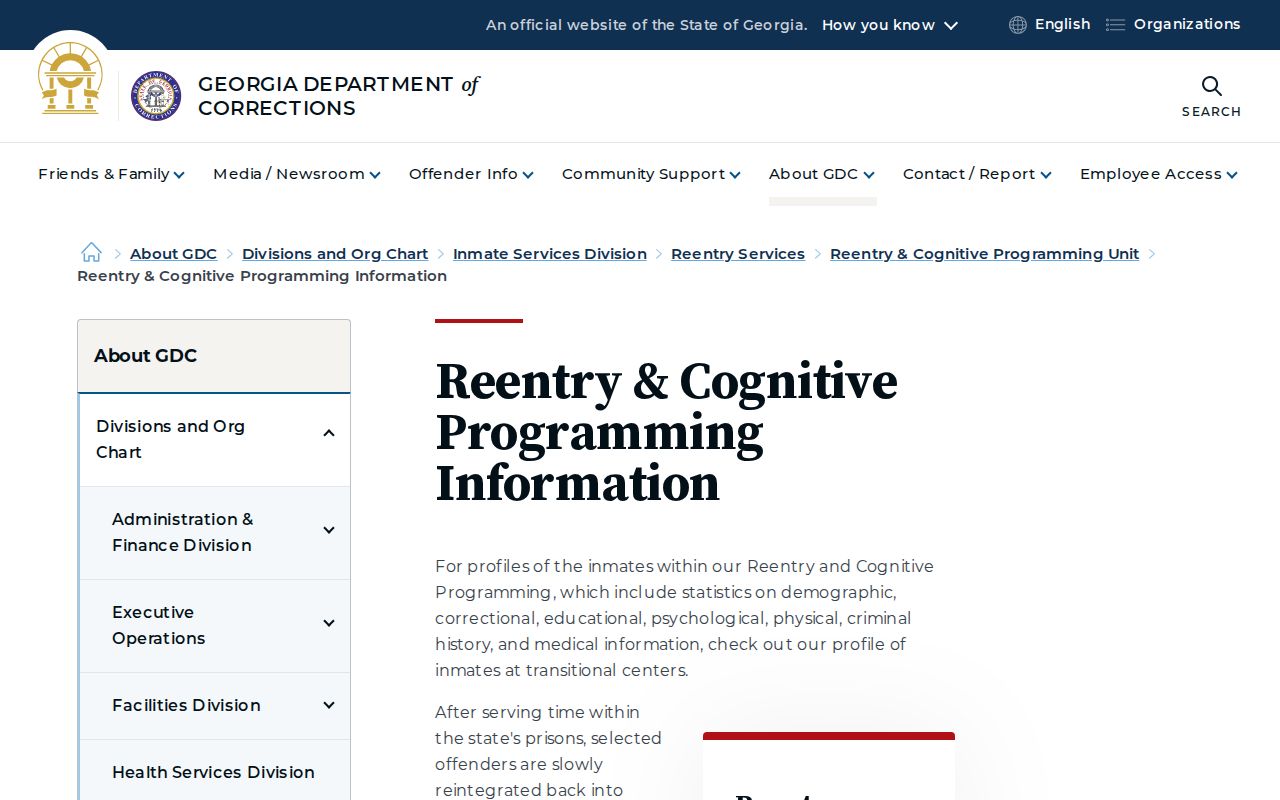
Use the offender record, Parole Board result, and DCS record to verify an actual transition from custody. Program information explains preparation, not release status.
Release planning may involve a proposed residence, supervision conditions, program completion, and coordination with field staff. None of those planning facts should be turned into an expected release date unless the Board and GDC records support it. A TPM can still move, and an approved parole plan can be affected by conduct or a detainer. The safest sequence is to check the GDC status, identify whether parole or sentence completion applies, then confirm the post-release supervision record.
Valdosta Detainer Transfer Context
Lowndes has a locally distinctive transfer issue because the sheriff publishes quarterly CATRA reports under Georgia's Criminal Alien Track and Report Act. Those county reports do not make Valdosta State Prison an ICE detention center, and they do not serve as GDC release records. They simply show why the word release must be read with care when another authority may have a hold.
A state offender may be paroled to a detainer or transferred rather than sent directly into the community. Confirm the departure in GDC and the parole decision through the Board. If another authority assumes custody, use that authority's record next. The Lowndes CATRA page is context only and should never replace the GDC offender search.